

UTV Part Fitment: How to Verify Fit Before You Buy

Last Updated: November 7, 2026
Quick Summary
To verify UTV part fitment, confirm your exact year, make, model, trim, and engine configuration using your VIN, then match the OEM part number in the manufacturer's catalog and compare published dimensions to your measured old part. UTV part fitment checks should include application notes, mid-year production splits, and the seller's return policy before you order.
- The VIN's position 10 character gives the model year the parts catalog follows, not the title year.
- The last six VIN digits help you pick the right part when a catalog shows two numbers for one model year.
- Measure the old part with calipers and compare it to the listing's published dimensions before ordering.
- A universal part usually means it fits with modification, which is where fitment fails.
- Steel Steeds accepts eligible returns within 30 days with no standard restocking fee.
Table of Contents
- Why UTV Part Fitment Fails More Often Than You Think
- How to Find UTV Model and Year Before Checking Fitment
- UTV Parts Compatibility by Year, Make, and Model
- OEM UTV Part Number Lookup: Reading the Catalog Correctly
- Aftermarket UTV Parts Compatibility and Cross-Referencing
- Fitment Checks by Part Category: Measure Before You Order
- Modifications, Conflicting Listings, and Pre-Purchase Verification
- Find My Parts: Confirm Fitment Before Checkout
- Frequently Asked Questions
Why UTV Part Fitment Fails More Often Than You Think
Most wrong-part orders don't happen because the buyer was careless. They happen because the listing said "fits most UTVs" and the buyer believed it. Learning how to verify UTV part fitment is really about learning where fitment data comes from, and where it goes wrong.
UTV part fitment is the process of confirming that a specific part matches your machine's exact year, make, model, trim, and engine configuration before you order. It sounds simple. In practice, side-by-side platforms share parts across model years, and aftermarket listings often blur those lines.
Three failure patterns cause most of the pain:
- Platform sharing: one part genuinely fits several models, so sellers label it broadly
- Model-year changes: a mid-cycle update quietly changes a mounting point or spline count
- Trim confusion: base and premium trims can run different drivetrain components under the same name
The fix is a repeatable check, not a leap of faith. Steel Steeds offers a vehicle-specific parts search tool. Below, we'll walk through the full verification workflow, from decoding your VIN to measuring a clutch before checkout. If you're working on an older machine, our walkthrough on how to verify ATV parts fit your older model goes deeper on aging platforms.
How to Find UTV Model and Year Before Checking Fitment
You cannot check UTV parts compatibility by year, make, and model until you know all three with certainty. The model name on the hood isn't enough. Start with the VIN, then confirm the details it doesn't tell you.
Decode the VIN and Serial Number
Your VIN is the ground truth for your machine.
Write down all 17 characters. Then match them against the manufacturer's VIN guide for your brand. The VIN encodes model year and plant, and it settles arguments a title or a memory can't.
Here is how to read the positions that matter for fitment:
- Position 10, model year. This is the character that tells you the production year the manufacturer assigned, which is not always the year on the title or the year the machine was first sold. A machine built in late 2022 can be titled as a 2023, and the parts catalog follows the VIN, not the title.
- Position 11, plant. Different assembly plants can source different subcomponents for the same model name. When a listing says "fits all," the plant code is one more reason to verify.
- Positions 4 through 8, model and body style. These characters distinguish two-seat from crew, base from premium, and short-bed from long-bed variants that share a nameplate.
Some UTVs use a shorter serial number instead of a full 17-character VIN, particularly older or off-road-only machines. Same rule applies: record it exactly and check it against the manufacturer's own documentation, not a forum post.
Watch out: a VIN plate that has been replaced, painted over, or riveted in a different location than the factory position is a red flag, verify the frame stamping matches the sticker before you trust either one.
Resolve Mid-Year Production Splits
A model year is not a single build. Manufacturers routinely change a component partway through a production run and keep selling the same nameplate. The VIN's sequence number, the last six digits, tells you roughly where in the run your machine was built. When a parts catalog shows two part numbers for the same model year, the sequence number is how you pick the right one.
The practical workflow is:
- Record the full VIN, including the last six digits.
- Open the manufacturer's parts catalog and enter the VIN if the catalog supports VIN lookup, many do, and it will filter to the correct production split automatically.
- If the catalog only accepts year, make, and model, note both part numbers shown for your model year and compare the sequence-number break point in the catalog notes to your own sequence number.
- When the break point is unclear, call a dealer parts counter with the VIN. They can pull the build record and confirm which revision your machine received.
A common pattern is a mid-year change to a clutch spline count, a belt width, or a wiring connector. Those are exactly the parts where a year-only filter fails.
Confirm Trim, Submodel, and Engine Displacement
The VIN gives you the base model. It won't always tell you the trim. Check these three things next:
- Trim badge or decal: DPS, XT, LE, and similar designations change parts
- Engine displacement: stamped on the engine case or listed on the emissions label
- Drivetrain layout: two-seat versus crew, and any factory packages
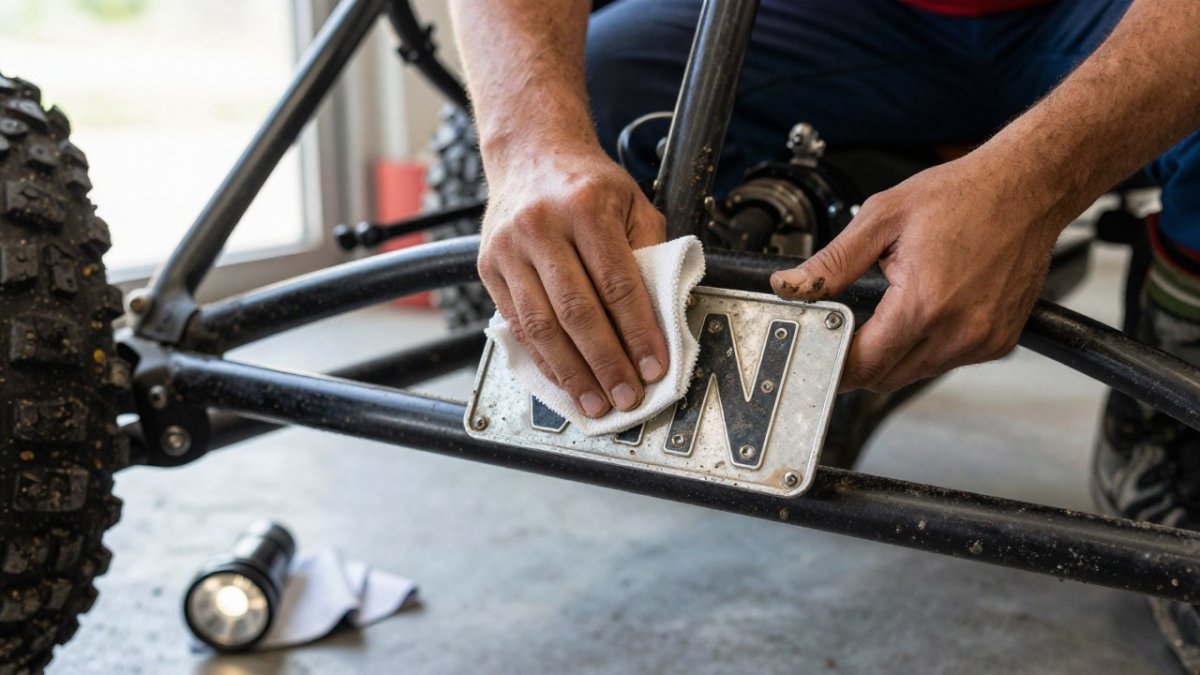
One common mistake is assuming a crew model shares parts with the two-seater. It often doesn't. Confirm the submodel before you search. The emissions label under the hood or on the frame is a second source for displacement and engine family when the case stamping is hard to reach.
UTV Parts Compatibility by Year, Make, and Model
Compatibility charts are a starting point, not a guarantee. A year-make-model filter narrows thousands of parts to dozens. It does not confirm the part will bolt on.
Here's how to read those charts without getting burned:
- Check the year range, not just the year. A listing for 2019-2024 may have exceptions inside that span
- Watch for mid-year splits. Some manufacturers change components partway through a production year
- Trust the application notes over the headline. The fine print is where exclusions live
Manufacturers publish their own fitment documentation, and it beats any third-party chart. When a seller's chart and the manufacturer's catalog disagree, the manufacturer wins every time.
If your machine has been modified, standard compatibility charts stop being reliable. Our guide to troubleshooting custom ATV build fitment issues covers how to work through conflicting information on modified machines.
OEM UTV Part Number Lookup: Reading the Catalog Correctly
An OEM UTV part number lookup is the most reliable fitment check you can run. The manufacturer assigned that number to a specific application. Match the number, match the part.
Here's the process:
- Open the manufacturer's parts catalog for your exact model and year
- Find the assembly diagram for the system you're repairing
- Note the part number and the quantity required
- Search that number, not a description
Part numbers are precise. A single digit can separate two visually identical parts with different splines or diameters. Never substitute a "close" number.
Watch out: sellers sometimes list a superseded part number alongside the current one. That's usually legitimate, but confirm the supersession on the manufacturer's own site before you trust it.
Aftermarket UTV Parts Compatibility and Cross-Referencing
Aftermarket UTV parts compatibility works differently. Aftermarket makers assign their own numbers, then publish a cross-reference to OEM numbers they replace. That cross-reference is your verification tool.
Follow this sequence:
- Find the OEM number for your machine first
- Search the aftermarket maker's catalog for that OEM number
- Confirm the aftermarket part's application notes list your exact model
- Check dimensions and mounting pattern against the OEM spec
A universal part is not a fitment guarantee. "Universal" usually means "fits with modification," and modification is exactly where fitment fails.
Sourcing matters too. Counterfeit parts circulate online, and a fake part with the right number on the box is still the wrong part. Buy from suppliers who publish real fitment data. Our list of reliable aftermarket UTV parts suppliers is a good place to start cross-referencing.
Fitment Checks by Part Category: Measure Before You Order
Every part category has one measurement that decides fit. Check that number before you order, not after the box arrives.
| Part Category | Key Check | What to Measure |
|---|---|---|
| Wheels and tires | Bolt pattern, offset, and clearance | Lug count and center-to-center spacing, backspacing, tire diameter versus fender and arm clearance |
| Suspension | Mount width and shock length | Eye-to-eye length, bushing width, bolt diameter |
| Clutch components | Spline count and diameter | Count splines, measure shaft diameter |
| Drive belts | Length and width | Measure old belt flat, compare to spec |
| Drive shafts | Spline count and length | End-to-end length, spline count both ends |
| Electrical parts | Connector type and pin count | Match plug shape, pin count, and voltage |
| Windshields and cabs | Mounting profile and model-year break | Compare hinge and clamp style to your cage |
| Mounting brackets | Bolt pattern | Center-to-center distance between holes |
| Bearings and seals | Inner and outer diameter | Caliper measure on the old part |
Wheels and tires. Bolt pattern is the first gate: count the lugs and measure center-to-center across the hub.
Suspension. Shock length is measured eye-to-eye with the shock off the machine and fully extended.
Clutch components and drive belts. Count splines by hand and measure shaft diameter with calipers.
Electrical parts. Connector shape, pin count, and voltage are the three checks. Two sensors that look identical can use different plug keys, and a stator or regulator rated for a different output will bolt on and then fail. Match the connector to a photo of your own harness plug before you order.
Windshields and cabs. These are the most model-year-sensitive accessories on a UTV. Hinge style, clamp diameter, and cage profile change between trims and mid-year revisions.
Accessories. Bumpers, roofs, and bed racks mount to factory holes that vary by submodel. Confirm the hole pattern and the presence of the mounting points on your machine before ordering.
Measure the old part with calipers, not a tape measure. Write the numbers down and compare them to the listing's published dimensions.
For clutch work specifically, having the right tool matters as much as the right part. Our clutch category includes purpose-built options, and the drive category covers drivetrain components with fitment details listed per application.
Modifications, Conflicting Listings, and Pre-Purchase Verification
A modified machine breaks the normal fitment rules. Lift kits, clutch kits, and aftermarket exhausts can shift mounting points or change clearances. Once you've modified a system, verify fitment against what's actually on the machine, not the factory spec.
When two listings conflict, work through this checklist:
- Confirm your exact year, make, model, trim, and engine size
- Pull the OEM part number from the manufacturer's catalog
- Cross-reference the aftermarket number against that OEM number
- Compare published dimensions to your measured old part
- Read the full application notes for exclusions
- Check the seller's return policy and fitment guarantee
- Confirm the part is genuine, not a counterfeit
- Save screenshots of the listing's fitment claims
That last step matters. If a part arrives and doesn't fit despite the listing saying it would, you have documentation for the return.
Find My Parts: Confirm Fitment Before Checkout
The final step is the simplest: confirm before you pay. A fitment check takes five minutes. A wrong part costs you a week of downtime and a return shipping label.
At Steel Steeds, we built our vehicle-specific parts search to do this work upfront. The vehicle-specific parts search tool helps you find parts for your machine. Expert fitment support is available to help confirm your application. Orders over $75 ship free, and eligible returns are accepted within 30 days with no standard restocking fee.
That's the whole point of verification.
Get started with Steel Steeds and order the right part the first time.
Fitment mistakes cost riding time, and most of them are avoidable with a VIN check and a caliper. Bring us your machine's details and we'll help you confirm the match before checkout. Our vehicle-specific parts search, expert fitment support, and 30-day return policy with no standard restocking fee are built for exactly this.
Frequently Asked Questions
How do I find the year, make, and model of my UTV?
Start with the VIN plate, usually on the left rear frame rail or under the bed, and decode positions 10 and 4-8 for model year and platform. The engine sticker and the manufacturer's parts catalog confirm displacement and trim. Write the full year, make, model, and submodel down before you search for any UTV part fitment, because a single missing character like an XT or DPS suffix can send you to the wrong part.
How can I tell if a UTV part fits my specific model?
Match three things: the manufacturer part number on the listing, the fitment notes that list your exact year, make, model, and trim, and the physical dimensions or mounting pattern shown in the product photos. If any of the three disagree, stop and confirm with the seller. A listing that only says universal or fits most UTVs is not a fitment guarantee, and returning a part that never matched your machine costs you time off the trail.
Can I use an OEM part number to verify fitment on an aftermarket part?
Yes. Take the OEM part number from the factory parts catalog, then check whether the aftermarket listing cross-references that number in its application notes. A legitimate aftermarket UTV parts compatibility claim will name the OEM number it replaces. If the listing has no cross-reference, ask the seller to confirm the OEM number before you order, and keep the reply in case you need to use a fitment guarantee or return.
Is a part compatible with every trim of the same UTV model?
No. Trims like DPS, XT, and MAX often change the clutch, suspension, or bed configuration, so the same model name can take different parts. The EPI Can-Am CVT Clutch Locking Tool is listed at $69.99 with fitment for specific Can-Am models. Always confirm the trim and submodel on the fitment table, not just the model name, before you order.

Leave a comment