

How to Verify ATV Parts Fit Your Older Model

Quick Summary
To verify ATV parts fit older models, first record your machine's year, make, model and trim, then match the VIN or frame number to the listing. Confirm the OEM part number against a parts diagram and measure the old part when the catalog falls short. Check bolt pattern and stud thread for wheels before you order.
- Write down year, make, model and trim before searching for any part.
- Mid-year changes are common, so always check trim and drivetrain as well as year.
- Use the frame or VIN number as the primary identifier; the engine number is a secondary check.
- Read supersession notes on OEM numbers, because a new number can still change the fit.
- Measure bolt pattern and stud thread to confirm wheel fitment before you buy.
Table of Contents
- Start With Your ATV's Identity: Year, Make, Model and Trim
- How to Find an ATV VIN, Frame Number and Engine Number
- ATV OEM Part Number Lookup: Matching Parts to Your Exact Machine
- Using an ATV Parts Compatibility Chart and Measuring for Fit
- Confirming Wheel Fitment With an ATV Bolt Pattern Guide
- Your Pre-Order Checklist Before You Buy at Steel Steeds
- Frequently Asked Questions
Start With Your ATV's Identity: Year, Make, Model and Trim
Last Updated: October 30, 2026
Before you buy a single part, you need to know exactly what you're working on, because the first step to a clean order is to verify ATV parts fit. A rider who orders a clutch or a wheel based on a rough memory of the machine often ends up with the wrong box.
Write those four facts down before you search anything. The year matters most on older machines, because manufacturers often changed components partway through a production run. The trim tells you whether you have a 2x4 or a 4x4, an EPS or a non-EPS unit, or a sport or utility version. Each difference can change the part you need.
Watch out: Many owners assume a same-year machine means identical parts. Mid-year changes are common, so always check the trim and drivetrain too.
Identifying an Older or Undocumented ATV Step by Step
Some older or modified ATVs have no paperwork and no clear badge. Work through the machine in this order:
- Read the model name stamped or decaled on the body panels or fenders.
- Note the engine size, which appears on the engine cover or in the owner's manual.
- Check drivetrain: count the wheels driven, and look for a front differential.
- Measure the wheelbase and ground clearance so you can compare them to catalog specs.
- Take clear photos of the frame, engine and any labels. You will need these when you shop.
If the machine has been modified, record every change. A swapped engine or a non-stock frame can make a catalog listing wrong for your build.
How to Find an ATV VIN, Frame Number and Engine Number
Your VIN or frame number is the most reliable way to identify the machine, but only if you can find it and read it correctly.
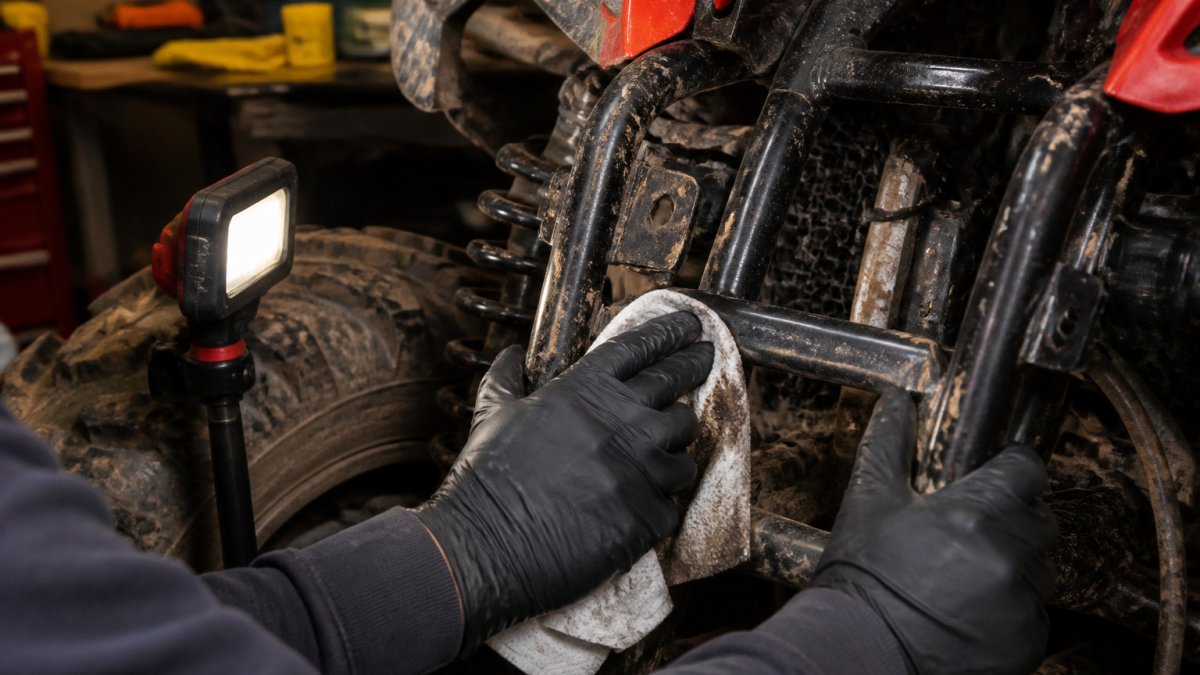
Wipe off dirt and grease before you look, and use a flashlight raking across the surface at a low angle, stamped characters disappear under flat lighting. A pencil rubbing over thin paper can lift a faint number that your eyes miss.
Decoding VINs, Frame Numbers and Engine Codes
A modern 17-character VIN is not random. The first three characters are the World Manufacturer Identifier, the first character is the region, the second is the manufacturer, and the third (with the first two) identifies the maker and plant.
Older ATVs often predate the 17-character standard. A frame number may be 9 to 12 characters, and an engine code may be a short alphanumeric stamp with no year at all. In that case the number identifies the machine family and production sequence, not a clean model year.
If a code does not match any published chart, do not guess. Record the full string exactly as stamped, note the engine displacement and drivetrain, and move to physical comparison. An undocumented machine is verified by measurement, not by a decoder.
The identifiers you need, where to look for them, and what each one tells you:
| Identifier | Where to find it | Why it matters |
|---|---|---|
| VIN | 17-character string on the left side of the frame | Most reliable way to identify the machine |
| Frame number | Steering neck, under the seat, or near the footwell on older machines | Primary identifier when no VIN exists |
| Engine number | Engine case near the cylinder base, clutch cover, or carburetor tag | Secondary check; a swapped engine shows modification |
| Lighting | Flashlight at a low angle | Stamped characters disappear under flat light |
ATV OEM Part Number Lookup: Matching Parts to Your Exact Machine
An OEM part number is the number the manufacturer assigned to a component, and it is the most precise way to confirm a match, but only if you use it correctly.
Start with a parts diagram, not a keyword search. A diagram shows the component in its assembly with an exploded view and a numbered callout, so you can confirm you are looking at the right part before you ever read a number.
EPI Polaris 325 Magnum 4X4 (Ebs) Clutch Rebuild Kit →
Supersessions, Cross-References and What a Number Change Means
When a manufacturer replaces a part, the old number is superseded by a new one. A supersession is usually a direct replacement, same fit, updated material or supplier, but not always. Some supersessions change a connector, a mounting hole, or a bearing size, and the catalog note will say so.
A cross-reference works the other way: it maps one manufacturer's number to another's, or to an aftermarket equivalent. Cross-references are useful for discontinued parts, but they are only as good as the source.
A good first check is the OEM number from your original owner's manual or parts diagram. Start there, then confirm the result against your frame or engine number. If the number has been superseded, follow the chain to the current number and read every note along the way. If the part is discontinued with no supersession, you are in physical-comparison territory, measure the old part and match dimensions, mounting points, and connectors before you buy.
Using an ATV Parts Compatibility Chart and Measuring for Fit
A compatibility chart lists which parts fit which machines. Use it as a filter, not a final answer. Charts can be incomplete, and some are built from older catalogs.
Look for these columns on any chart you use: year range, make, model, trim and drivetrain. If a row only lists the model name, confirm the year range before you trust it.
When Catalogs Are Incomplete: Physical Measurement and Visual Comparison
When the chart runs out, measure the old part so you can verify ATV parts fit by hand. Take the length, width, bolt spacing, bore diameter or shaft size with a caliper or tape. Compare those numbers to the listing.
Visual comparison catches what numbers miss. Look at the mounting tabs, connectors, and the angle of the bracket. A part that looks almost the same can still sit in the wrong place.
Confirming Wheel Fitment With an ATV Bolt Pattern Guide
Wheel fitment depends on bolt pattern, offset and hub size. Count the lug holes and measure the distance across the pattern, from the center of one hole to the opposite one. Then check that number against the guide for your machine.
Check the wheel studs and nuts too. Replacement studs must match the hub thread and length. If your stud thread or length is wrong, the wheel will not seat safely.
Your Pre-Order Checklist Before You Buy at Steel Steeds
Before you check out, confirm these points:
- Year, make, model and trim written down
- VIN or frame number recorded and matched to the listing
- Engine number checked where the part depends on engine type
- OEM part number compared with your original parts diagram
- Physical measurements taken for anything the chart does not cover
- Bolt pattern and stud thread verified for wheel parts
Steel Steeds offers a vehicle-specific parts search and expert fitment support. Free shipping applies on orders over $75, and returns on eligible new, unused items are accepted within 30 days with no standard restocking fee. If you are unsure about a match, contact the team to talk through your machine details before you buy.
Frequently Asked Questions
Where can I find the VIN on an ATV?
Check the frame, usually near the steering column, under the front rack or along the frame tube near the engine mount, depending on the model. Many ATVs also list a frame or serial number on a sticker or stamped plate. If the VIN is unreadable, note the engine serial number and the model code stamped on the crankcase, then use those with your year, make and model to narrow down fitment before ordering any part at Steel Steeds.
Can parts from different ATV model years interchange?
Sometimes, but not reliably. Manufacturers often change components mid-year, and a part that fits a 2001 model may not fit a 2002 unit with a revised frame, engine or suspension geometry. Compare the part number on the original component with the replacement listing, check the year range on the fitment table, and confirm the application against your exact VIN or engine number before buying.
How do I check an ATV part number against my model?
Start by finding the OEM part number printed in your owner's manual or on the original part. Then search for that number in the Steel Steeds vehicle-specific parts search tool and confirm the listed year, make, model and submodel match your machine. If a listing only shows a general application, measure the part and compare it with the original before installing it.
How can I tell whether a replacement part fits my ATV?
Compare the replacement with the original part by number, dimensions and mounting points. Check bolt holes, connector shape, bore size or wheel bolt pattern against your machine. If anything is unclear, contact the Steel Steeds fitment support team with your VIN and the part numbers you are comparing, and keep the original part until you confirm the match.

Leave a comment