

How Do You Find Motorcycle Part Numbers?

Last Updated: November 1, 2026
Quick Summary
You find motorcycle part numbers by starting with your bike's VIN, then using the manufacturer's parts fiche by year and model to match the exploded diagram callout to the numbered parts list. Confirm the number against your VIN, model year, and a second catalog before ordering.
- A VIN is the 17-character code identifying your motorcycle's model year, plant, and build details.
- The callout number on an exploded diagram is not the part number; the numbered list holds the product number.
- Write the full part number exactly as shown, including hyphens and suffixes, to avoid wrong color or side.
- A supersession note means the factory replaced the original part with a revised version for the same application.
- Steel Steeds offers free shipping on orders over $75 and 30-day returns with no standard restocking fee.
Table of Contents
- Start With Your Bike's Identity: VIN, Frame, and Engine Numbers
- Using a Motorcycle Parts Fiche by Year and Model
- How to Verify Motorcycle Part Fitment Before You Order
- Motorcycle OEM Parts Lookup: Reading Part Numbers and Supersessions
- What to Do When the Label, Diagram, or Number Is Missing
- Find My Parts: Look Up Your Motorcycle Part Numbers at Steel Steeds
- Frequently Asked Questions
Start With Your Bike's Identity: VIN, Frame, and Engine Numbers
Finding the right motorcycle part numbers starts with one thing: knowing exactly what machine you own. A fuzzy model ID is one of the most common sources of wrong orders.
A VIN, or Vehicle Identification Number, is the 17-character code that identifies your specific motorcycle, including its model year, plant, and build details. It is the fastest way to lock in the right parts fiche.
Where to Find the VIN on Your Motorcycle
Most bikes stamp the VIN on the steering head tube, right where the fork meets the frame. Look for a metal plate or a stamped strip on the right side of the neck. On some models, a sticker on the frame downtube carries the same number. Write it down exactly, character by character. A single swapped digit can pull up a completely different model year and the wrong part.
Why Frame and Engine Numbers Matter for Older or Modified Bikes
VINs get reused across trims, and older or heavily modified bikes often fall outside the standard catalog. That is where frame and engine numbers save you. The frame number tells you which generation of the chassis you have. The engine number confirms the exact motor, which matters when a previous owner swapped parts. Older machines are sometimes missing from a catalog, and the frame and engine numbers can help identify them.
Using a Motorcycle Parts Fiche by Year and Model
A parts fiche is the manufacturer's illustrated catalog of every component on a given model, organized by year and model so you can browse exact parts.
Start by selecting your make, then your model, then the model year. Trim level and color matter too: the same bike can carry different bodywork and graphics depending on the color label.
Reading an Exploded Diagram and Diagram Callouts
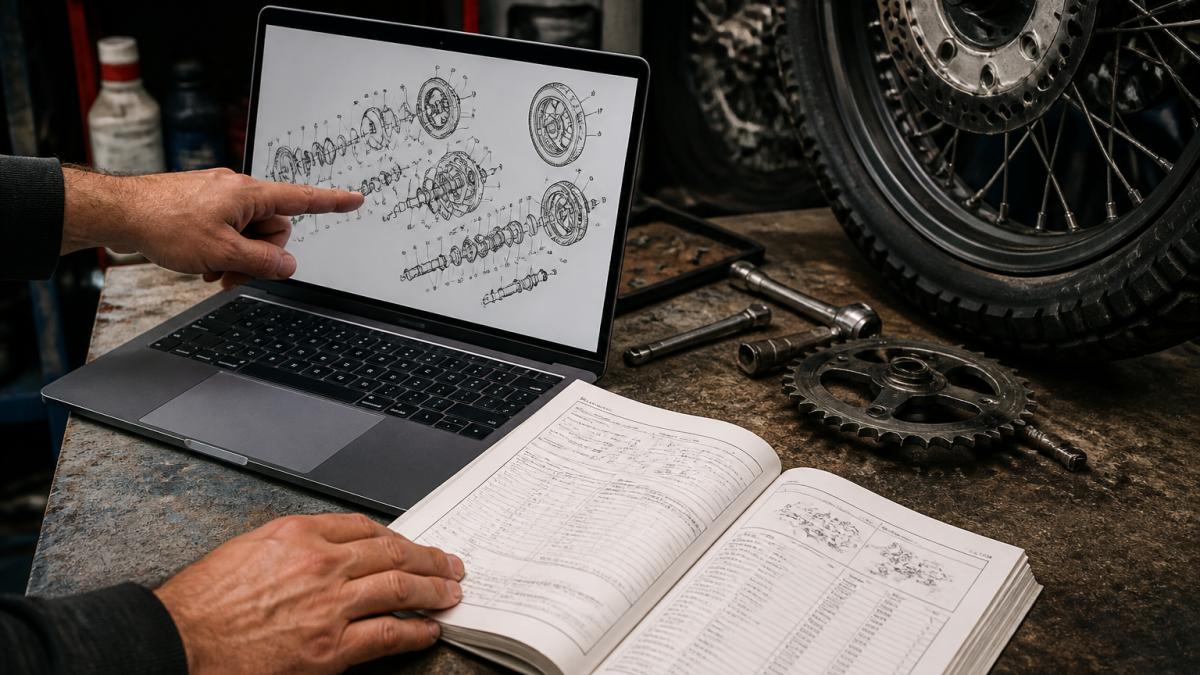
An exploded diagram shows the assembly pulled apart, with each part tagged by a callout number. Find the assembly you need, match the callout to the numbered list beside the diagram, and you land on the exact part number. A common mistake is grabbing the callout number itself as the part number. They are not the same. The callout points you to the product number in the list, and that is what you order.
How to Verify Motorcycle Part Fitment Before You Order
Fitment is the single check that separates a smooth repair from a return. To verify motorcycle part fitment, cross-check the part number against your VIN, your model year, and the diagram callout before you pay.
Here is the workflow we recommend:
- Confirm the part number matches your year and model in the fiche.
- Check the compatibility notes for trim or color differences.
- Compare the number against a second catalog or seller listing.
- Look for any supersession note replacing the old number.
- Confirm the part is available and can ship to you.
Before you pay, run through these fitment checks in order. For older machines, see How to Verify ATV Parts Fit Your Older Model for a deeper walkthrough.
| Step | What to do |
|---|---|
| 1 | Confirm the part number matches your year and model in the fiche |
| 2 | Check compatibility notes for trim or color differences |
| 3 | Compare the number against a second catalog or seller listing |
| 4 | Look for any supersession note replacing the old number |
| 5 | Confirm the part is available and can ship to you |
Motorcycle OEM Parts Lookup: Reading Part Numbers and Supersessions
A motorcycle OEM parts lookup rewards patience, because the number itself tells a story. OEM stands for original equipment manufacturer, meaning genuine parts built to the factory spec. Aftermarket parts can work, but the OEM number is your anchor. The gap most lookup guides leave open is what the number actually means and what to do when the factory revises it.
Decoding Part Number Formats
Most manufacturers build part numbers in blocks, but the block logic is not universal. A common pattern is a prefix that identifies the assembly or component group, a middle segment tied to the model or generation, and a suffix that flags a color, a side, or a revision.
A practical habit is to read the number in segments and match each segment against the fiche listing rather than pattern-matching the whole string.
Understanding Supersessions and Replacement Numbers
Manufacturers revise parts, and when they do, the old number is often superseded by a new one. A supersession note means the factory replaced the original part with a revised version that is intended to fit the same application. The trap is that sellers sometimes list the superseded number under the old one, or the reverse, so the same physical part can appear under two numbers.
When you find a supersession note, confirm three things: the new number is listed for your year and model, the fitment notes do not exclude your trim or color, and the seller is shipping the current revision rather than old stock. If a number has been superseded more than once, work from the most recent number backward and verify each step against the fiche. A part that is discontinued with no supersession is a different problem, that is when you move to the cross-check and specialist steps below.
Cross-Checking a Number Across Catalogs and Sellers
Never trust a single listing. Search the full part number in a second catalog and compare the fitment notes. A verification checklist helps:
- Confirm the number appears in the fiche for your exact year, model, and trim.
- Compare the diagram callout and the part description against the second source.
- Check whether either listing carries a supersession or replacement note.
- Confirm the fitment table does not exclude your VIN range or market variant.
- Verify the seller's return policy before ordering a revised or superseded number.
If two sources agree on the number and the fitment, your odds of a correct order climb fast. If they disagree, treat the disagreement as a signal to slow down rather than pick the cheaper listing.
What to Do When the Label, Diagram, or Number Is Missing
Missing numbers are common on older bikes and worn parts, and this is where most lookup guides stop short. A worn or absent identifier does not mean the part is unidentifiable, it means you need a fallback workflow that rebuilds the identification from other evidence.
When the VIN or Frame Label Is Worn
Start with the locations that survive wear best. The steering-head stamp is usually deeper than a sticker, and the frame downtube plate often outlasts a decal.
For older machines, the catalog may skip your build entirely. In that case, use the frame and engine numbers to establish the generation, then search the fiche for the nearest documented year and compare the diagram against your actual assembly.
When the Diagram Is Unclear or the Number Is Gone
Work from the physical component outward. Search by part name or description, then match the shape, mounting points, and location to your machine.
If the number itself is worn off, describe the component and its location to a parts specialist. Describing the component, its location, and the frame or engine number to a parts specialist can help narrow it down.
A Fallback Order of Operations
When identifiers are missing, work in this order: frame or engine number to establish the model and generation, then the nearest fiche year, then the exploded diagram to locate the assembly, then a description or measurement search, and finally a specialist confirmation. Each step narrows the candidate list, and the final confirmation prevents a plausible-looking number from becoming a return.
Find My Parts: Look Up Your Motorcycle Part Numbers at Steel Steeds
The fastest way to skip the guesswork is a tool built for your machine. Steel Steeds offers a vehicle-specific parts search tool and expert fitment support to help you find the right parts for your machine.
Steel Steeds offers free shipping on orders over $75 and 30-day returns with no standard restocking fee.
Get started with Steel Steeds and find the exact part numbers for your bike in minutes.
Frequently Asked Questions
Can I use my VIN to look up motorcycle parts?
Yes. Your VIN identifies the exact model year, model variant, and often the production run your bike came from, which is the starting point for any motorcycle VIN parts lookup. Enter the full 17-character VIN into a vehicle-specific parts search tool or a manufacturer parts catalog, and it narrows the catalog to parts built for your machine. For older or heavily modified bikes, cross-check the frame and engine numbers too, since the VIN alone may not reflect aftermarket changes made over the years.
Are motorcycle part numbers the same across model years?
Not always. Many motorcycle part numbers carry over between model years when the component is unchanged, but manufacturers also revise numbers when a part is updated, superseded, or fitted to a different trim or color. A supersession means the old number is replaced by a new one that still fits, while a compatibility change means the part no longer works on your bike. Always verify the number against your specific year, model, and variant in a parts fiche before ordering, even if a seller lists the part as fitting your model.
How can I tell if a motorcycle part will fit my bike?
Match the part number to your exact model year, model variant, and where applicable the color or trim code shown in the parts diagram. Then check the diagram callout to confirm the part sits in the same location and assembly on your bike. If you are buying aftermarket parts, compare the manufacturer's fitment notes against your VIN and frame number. When in doubt, ask a fitment specialist to confirm before you order, since a part that looks identical can differ in mounting points or dimensions between model years.
Where can I find a parts diagram for my motorcycle?
Manufacturer parts catalogs and vehicle-specific parts search tools publish exploded diagrams organized by year, make, and model. You select your bike, choose the assembly you need (for example, the front fender or engine), and the diagram shows each component with a numbered callout and part number. If you do not know the part name, browse the diagram by location instead. Keep your VIN or frame number handy so you land on the correct diagram for your exact variant rather than a similar model.
Your next repair should not stall on a wrong part number. Let Steel Steeds take the guesswork out of fitment with our vehicle-specific search tool, real expert support, and returns that respect your time. Get started with Steel Steeds and get back to riding faster.

Leave a comment